Parsons Organ Co.
Opus 10, 1995
Originally Hook & Hastings (Opus 2020, 1904)
First Lutheran Church
400 Main Street
Watsontown, PA, US
23 Ranks - 1,320 Pipes
EXPLORE IMAGESVIEW STOPLISTSomething not quite correct?Suggest an Edit
🤝 Instrument entries in Pennsylvania sponsored by:
We are grateful for the generous support of our sponsors, who make it possible for us to continue our mission of preserving and promoting the rich history of pipe organs across the globe.


IMAGES

Something missing or not quite correct?Add ImageorSuggest an Edit
STOPLISTS
| Great (I) | ||
| 16' | Lieblich Gedeckt | SW |
| 8' | Principal | 61 |
| 8' | Hohlflute | 61 |
| 8' | Dulciana | 61 |
| 4' | Octave | 61 |
| 4' | Chimney Flute | 61 |
| 2' | Fifteenth | 61 |
| III-V | Mixture | 251 |
| 8' | Trumpet | 61 |
| 4' | Clarion | 12 Trumpet |
| Chimes | ||
| 16' | Great to Great | |
| Great Unison Off | ||
| 4' | Great to Great | |
| 16' | Swell to Great | |
| 8' | Swell to Great | |
| 4' | Swell to Great |
| Swell (II - Expressive) | ||
| 16' | Lieblich Gedeckt | 12 Gedeckt |
| 8' | Gedeckt | 61 |
| 8' | Viola | 61 |
| 8' | Viola Celeste TC | 49 |
| 4' | Principal | 61 |
| 4' | Harmonic Flute | 61 |
| 2 2⁄3' | Nasard | 61 |
| 2' | Gemshorn | 61 |
| 1 3⁄5' | Terz | 42 |
| 16' | Bassoon | 12 Oboe |
| 8' | Oboe | 61 |
| Tremulant | ||
| 16' | Swell to Swell | |
| Swell Unison Off | ||
| 4' | Swell to Swell |
| Pedal | ||
| 32' | Resultant | |
| 16' | Subbass | 32 |
| 16' | Lieblich Gedeckt | SW |
| 8' | Principal | 32 |
| 8' | Gedeckt | SW |
| 4' | Choral Bass | 12 Principal |
| 4' | Gedeckt | SW |
| 16' | Contra Trumpet | 12 GT |
| 16' | Bassoon | SW |
| 8' | Trumpet | GT |
| 4' | Oboe Schalmei | SW |
| 8' | Great to Pedal | |
| 4' | Great to Pedal | |
| 8' | Swell to Pedal | |
| 4' | Swell to Pedal |
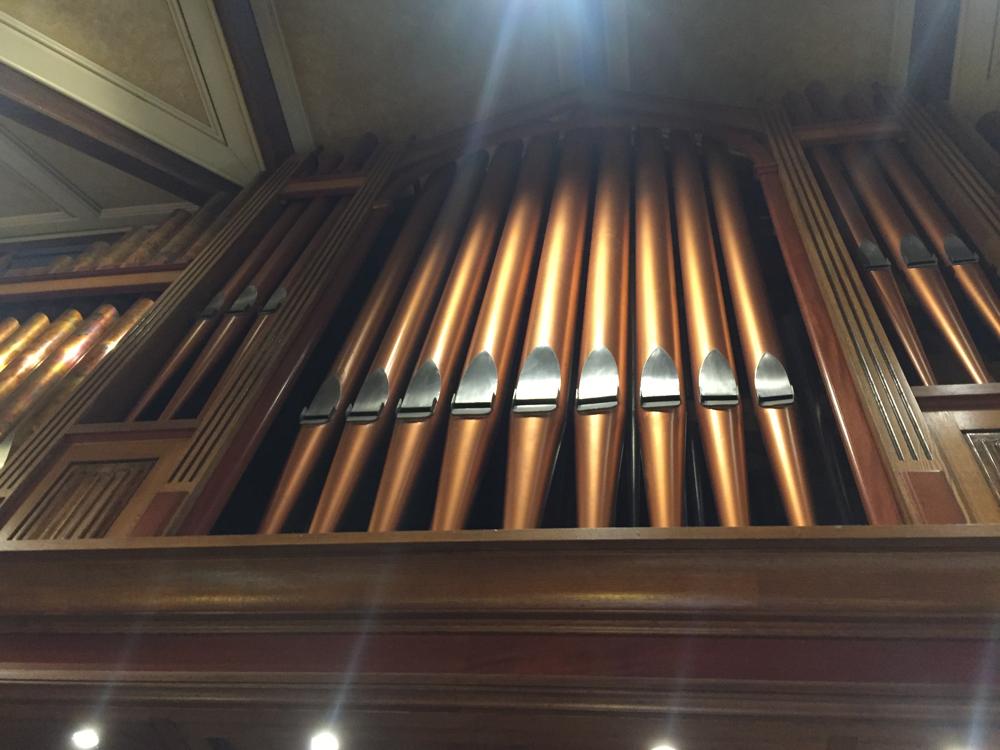
32 Levels of memory, Transposer, MIDI capable. From the Open House brochure: "The instrument at the First Evangelical Lutheran Church of Watsontown, PA, originated as the Hook and Hastings, Opus 2020, 1904. This Hook and Hastings instrument contained 14 speaking stops and employed tubular pneumatic action. The instrument underwent one rebuild in the 1940's when the Moller Organ Company electrified the tubular action, removed the casework and installed a new console. The [vocal] choir and console were placed downstairs and the existing instrument was tonally altered and a new enclosure was built around the pipework. The result was less than satisfactory, both tonally and mechanically, due to an unresponsive action and an enclosure that drastically hindered tonal egress. To correct these shortcomings, we designed a new case incorporating a cantilevered design concept allowing us to relocate the [vocal] choir, piano and organ console to the original musician's gallery. The casework is of quartered red oak with mahogany accents. Mechanically, we retained the Hook slider chests and modified them for electric control. A new solid state control system now operates both switching functions and combination action. Winding was reconfigured retaining existing regulators and incorporating a new blower. Tonally, most of the Hook and Hasting pipework was retained, repaired and extensively revoiced. New Principal and Reed pipework was added to complete those choruses. "
Open In New TabSomething missing or not quite correct?Add StoplistorSuggest an Edit
CONSOLES
Builder: Unknown
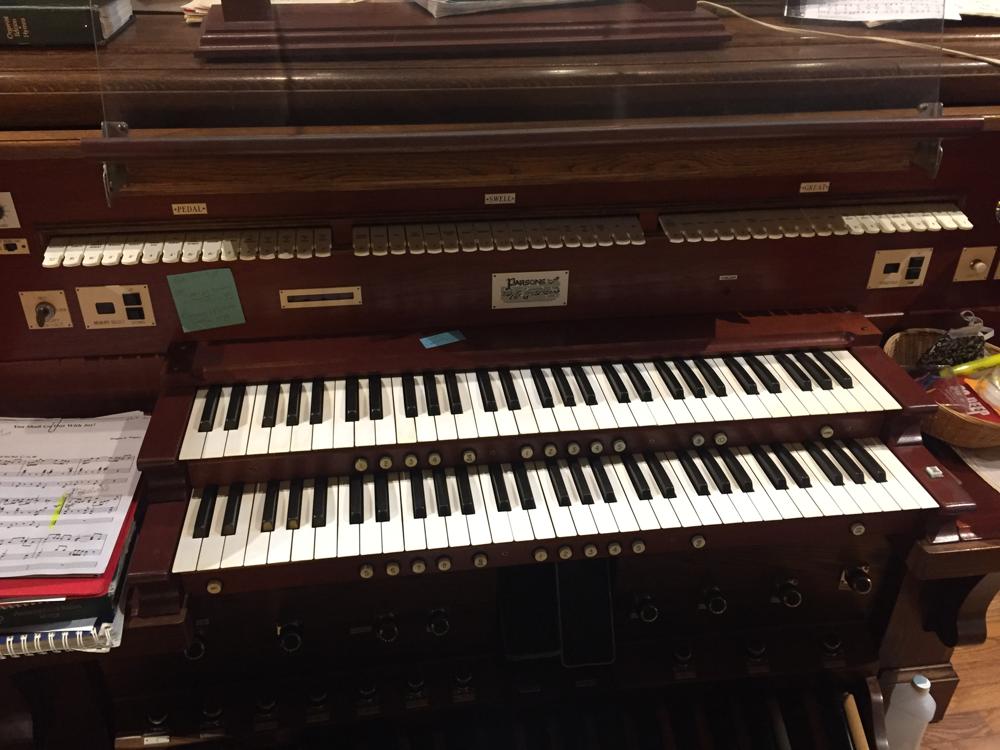
Position: Console in Fixed Position, Center
Design: Traditional With Roll Top
Pedalboard Type: Concave Radiating (Meeting AGO Standards)
Features:
2 Manuals 3 Divisions32 StopsMechanical With Pneumatic Assists Key ActionElectrical Stop ActionCrescendoCombination Thumb Piston(s)Sforzando Thumb Piston(s)Sforzando Toe Piston(s)Stop Layout: Tilting/Rocking Tablets Above Top Manual
Expression Type: Balanced Expression Shoes/Pedals (Meeting AGO Standards)
Combination Action: 'Hold and Set' Pneumatic/Mechanical
Control System: Unknown or N/A
Something missing or not quite correct?Add ConsoleorSuggest an Edit
DETAILS
This instrument is: Extant and Playable in this location
Updated through online information from James R. Stettner. -- Three-sectional facade with 29 pipes arranged: 7-3-9-3-7. Source: builder's website.
Database Manager on April 16th, 2008:
Updated through online information from Constance Fladland. -- Rebuild of 1904 Hook & Hastings, Opus 2020. Parsons added 32 levels of memory and a transposer.
Database Manager on March 1st, 2005:
Identified from company publications as edited and expanded in The Hook Opus List 1829-1935, ed. William T. Van Pelt (Organ Historical Society, 1991).
Webpage Links: [Builder's web site]
Related Instrument Entries: Hook & Hastings Co. (Opus 2020, 1904)
Something missing or not quite correct?Add NoteorAdd WebpageorAdd Cross ReferenceorSuggest an Edit