E. & G. G. Hook
Opus 314, 1862
First Congregational Church (Unitarian)
71 Eighth Street
New Bedford, MA, US
43 Ranks - 2,273 Pipes
Instrument ID: 14793 ● Builder ID: 1834 ● Location ID: 9478
⬆️ These are database IDs that may change. Don't use as academic reference.EXPLORE IMAGESVIEW STOPLISTSomething not quite correct?Suggest an Edit
Plenum Organ Company
🤝 Instrument entries in Massachusetts sponsored by:
We are grateful for the generous support of our sponsors, who make it possible for us to continue our mission of preserving and promoting the rich history of pipe organs across the globe.

IMAGES


Something missing or not quite correct?Add ImageorSuggest an Edit
STOPLISTS
| GREAT ORGAN🛈 | ||
| 16' | Double open diapason and bourdon bass | 56 |
| 8' | Open diapason | 56 |
| 8' | Claribella [sic] & stopped diap. Bass | 56 |
| 8' | German gamba | 56 |
| 4' | Hohl flute | 56 |
| 4' | Principal | 56 |
| 2⅔' | Twelfth | 56 |
| 2' | Fifteenth | 56 |
| IV | Mixture | 244 |
| Blank [sic] | ||
| 8' | Trumpet | 56 |
| 4' | Clarion | 56 |
| CHOIR ORGAN🛈 | ||
| 16' | Æolina (to tenor c) | 44 |
| 8' | Viol d' amour | 56 |
| 8' | Dulciana | 56 |
| 8' | Stopped diapason | 56 |
| 8' | Melodia (to tenor c) | 44 |
| 4' | Celestina | 56 |
| 4' | Flute a cheminée | 56 |
| 2' | Piccolo | 56 |
| III | Mixture | 168 |
| 8' | Clarionette and Fagotto bass | 56 |
| SWELL ORGAN🛈 | ||
| 16' | Bourdon bass | 12 |
| 16' | Bourdon treble | 44 |
| 8' | Open diapason | 56 |
| 8' | Stopped diapason | 56 |
| 8' | Dulciana (to tenor c) | 44 |
| 4' | Flute harmonique | 56 |
| 4' | Principal | 56 |
| III | Cornet | 168 |
| 16' | Teneroon trumpet (to tenor c) | 44 |
| 8' | Trumpet | 56 |
| 8' | Oboe (to tenor c) | 44 |
| Blank |
| PEDAL ORGAN🛈 | ||
| 16' | Double open diapason | 27 |
| 16' | Double dulciana | 27 |
| 5⅓' | Stopped quint | 27 |
| 8' | Violoncello | 27 |
| 16' | Posaune | 27 |
| Blank |
| MECHANICAL STOPS | ||
| Couple Great and Swell | ||
| Couple Choir and Swell | ||
| Couple Pedal to Great | ||
| Couple Pedals to Choir | ||
| Couple Pedals to Swell | ||
| Tremulant Swell | ||
| Bellows signal | ||
| Pedal check |
Order as published in 1871
Originally Written/Published: Sat., January 7, 1871
Something missing or not quite correct?Add StoplistorSuggest an Edit
CONSOLES
Builder: Unknown
Position: Unknown
Design: Unknown
Pedalboard Type: Unknown
Features:
3 Manuals 47 RegistersStop Layout: Unknown
Expression Type: Unknown
Combination Action: Unknown
Control System: Unknown or N/A
Something missing or not quite correct?Add ConsoleorSuggest an Edit
DETAILS
This instrument is: Extant and Not Playable in this location
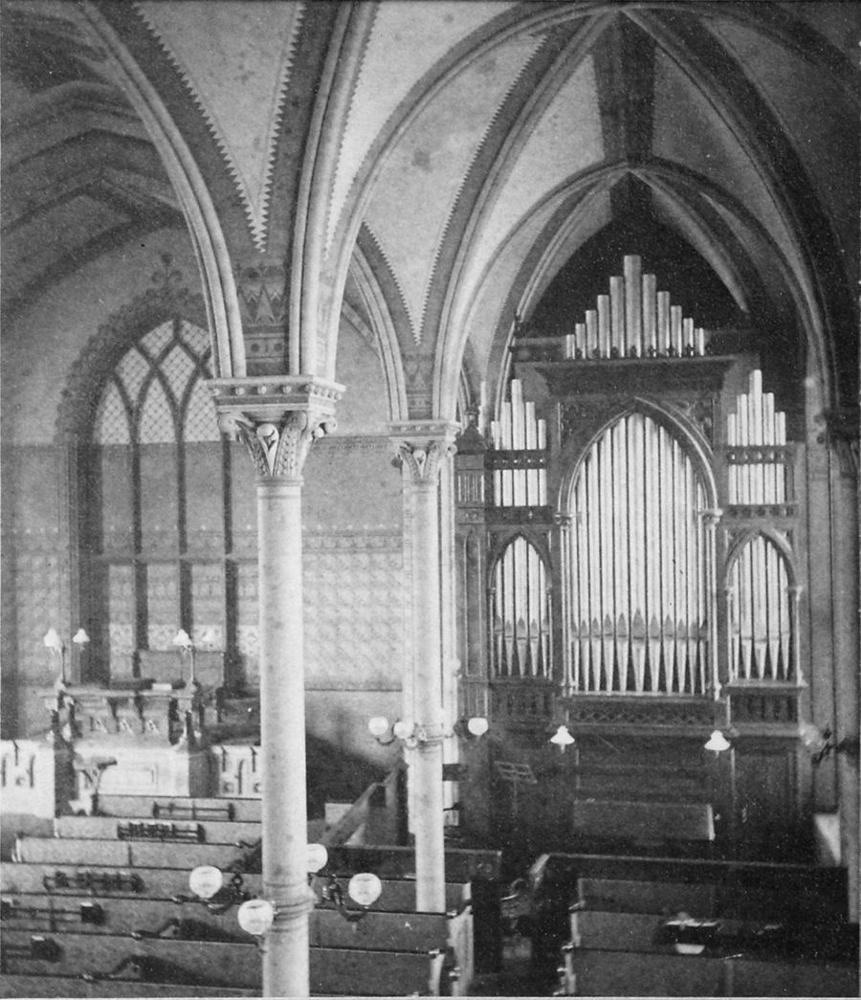
The organ in the Unitarian Church, New Bedford, Mass., was built by Messrs. E. and G. G. Hook, of Boston. The opening exhibition took place in the church on Friday evening, June 13th, 1862. Mr. A. T. Thorup, the organist of the church, Messrs. Wilcox and J. W Hervey played, and Miss H. E. Booth and. the choir sang. Mr. Thorup prepared the specification. The manuals· of this organ were about the first made in this country to overhang each other, which method was then announced as 'on a new plan.' This organ has three manuals, each of a compass of 56 notes, from CC to gin alt., and pedal bass compass of 27 notes, from CCC-tenor d. The case, of gothic architecture, is of solid chestnut, and the front pipes are of burnished tin. It has 37 sounding stops and 2,273 pipes, which are as follows...[see stoplist tab]
-- "The Organ," New York Weekly Review of Music, Drama, Literature, Fine Arts, and Society 22:2 (Sat., January 7, 1871).
Paul R. Marchesano on May 25th, 2022:
"...the third instrument, E. & G. G. Hook Op. 314, was installed in the rear gallery. This instrument was at the time the largest organ in New Bedford, and it was this organ that Ralph Waldo Emerson heard when he served as interim minister of the church 1866-7. In 1874, architect William Ralph Emerson was engaged to "Victorianize" the church, and he recommended that the organ be moved to the front near the pulpit; the organ was indeed moved."
-- 2005 OHS Handbook
Database Manager on March 10th, 2007:
Updated through online information from Bruce Gardzina. -- Rebuilt in 1891 by Hutchings. Incorporated into 1907 Hutchings-Votey. Replaced by 1966 Flentrop. Destroyed/dispersed (Laws Jr.)
Database Manager on February 28th, 2005:
Identified from company publications as edited and expanded in The Hook Opus List 1829-1935, ed. William T. Van Pelt (Organ Historical Society, 1991).
Related Instrument Entries: Geo. S. Hutchings (& Co.) (Opus 245, 1891) , Hutchings-Votey Organ Co. (Opus 2075, 1907)
Something missing or not quite correct?Add NoteorAdd WebpageorAdd Cross ReferenceorSuggest an Edit