Garret House
1865
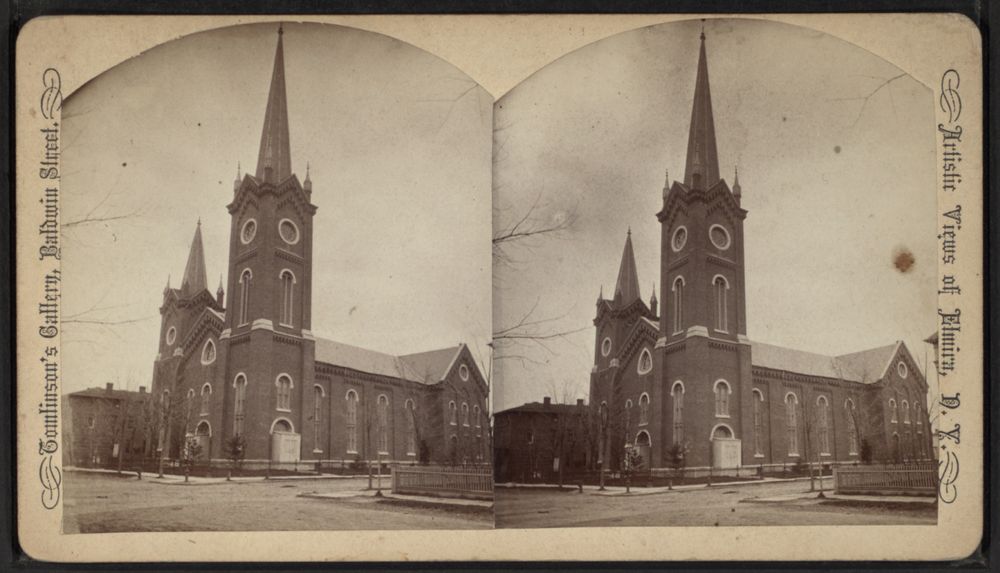
First Presbyterian Church (1862)
Baldwin and Church Streets
Elmira, NY, US
22 Ranks - 1,129 Pipes
EXPLORE IMAGESVIEW STOPLISTSomething not quite correct?Suggest an Edit
This instrument has multiple revisions:
IMAGES
Something missing or not quite correct?Add ImageorSuggest an Edit
STOPLISTS
| Great (I)🛈 | ||
| 16' | Double Open Diapason | 44 |
| 8' | Grand Open Diapason | 56 |
| 8' | Stopped Diapason Treble🛈 | 44 |
| 8' | Stopped Diapason Bass🛈 | 12 |
| 8' | Dulciana | 44 |
| 8' | Dulciana bass | 12 |
| 8' | Viol d'amour & Violincello | 56 |
| 4' | Principal | 56 |
| 4' | Walde [sic] Flute | 56 |
| 3' | Twelfth | 56 |
| 2' | Fifteenth | 56 |
| 8' | Trumpet treble🛈 | 44 |
| 8' | Trumpet bass🛈 | 12 |
| 8' | Swell to Great |
| Swell (II - Expressive)🛈 | ||
| 16' | Double Stopped Diapason | 44 |
| 16' | Bourdon bass | 12 |
| 8' | Open Diapason | 44 |
| 8' | Stopped Diapason | 44 |
| 8' | Clarabella | 44 |
| 8' | Stopped Diapason bass | 12 |
| 4' | Principal | 44 |
| 4' | Principal bass | 12 |
| 2' | Picolo [sic] | 44 |
| III | Dulciana Cornet🛈 | 168 |
| 8' | Trumpet | 44 |
| 8' | Hautboy | 44 |
| Pedal🛈 | ||
| 16' | Double Open Diapason | 25 |
| 8' | Great to Pedal | |
| 8' | Swell to Pedal |
Tremulant (French pattern); Bellows Alarm; Pedal Check. The instrument reported as containing 22 ranks and 1149 pipes.
Originally Written/Published: September 1, 1865
Something missing or not quite correct?Add StoplistorSuggest an Edit
CONSOLES
Features:
2 Manuals 3 Divisions32 RegistersMechanical (Unknown) Key ActionMechanical Stop ActionStop Layout: Unknown
Expression Type: Unknown
Combination Action: Unknown
Control System: Unknown or N/A
Something missing or not quite correct?Add ConsoleorSuggest an Edit
DETAILS
From the Elmira Daily Advertiser (September 1, 1865):
"The largest organ in our city is just being put up in the First Presbyterian Church. The manufacturer is now engaged in adjusting and tuning the pipes, and it will be complete and ready to show off the music there is in it by Friday next. The instrument has ben built after the substantial order, containing all the well approved and long tried stops, with enough of the brilliant and novel kind to give brilliancy and piquancy to the reliable and fundamental organ music. And when we speak of the attention that has been paid to the fundamental parts of the organ, we do not intend to have it understood that the tone and quality is by any means of the average order, but in its peculiar finish, roundness and distinctness, it is far above what is usually heard in such an instrument. The latest mechanical arrangements have been introduced in the instrument.
The tremolo [sic] stop is arranged after the French pattern, and acts with singular silence when under the influence of a full blast from the bellows, its action being controlled by the easy adjustment of a spring, which allows the most free and easy play. The bellows work also by a simple and noiseless arrangement of webbing and a fulcrum playing back and forth over a flat groove, instead of a socket, into which the fulcrum pin is usually adjusted.
The coupling mechanism, with a pitman lying between the eyes, is so made as to allow a perfect disconnection with the keys under ordinary circumstances. And when adjusted, the act of pulling out and pitting in the stop is done with great ease. While all the fundamental stops in tone and quality are especially praiseworthy, the viol d'amour is particularly noticeable among those not so commonly used. Of the reed stops we cannot speak with understanding; neither can we give an idea of the organ in its fullness and completeness, having been permitted to listen yesterday, only to the quality of the fundamental stops, nearly put in order. A professional organist present expressed himself much pleased with the tones that were played, and we are informed that the distinguished organist, George W. Morgan, of New York City, who practiced on the instrument while in the manufactory, at Buffalo, pronounced the tone and quality of the various stops excellent. We expect that our citizens will have the privilege of listening to a grand trial of the instrument ere many days. We home that C. G. Degenhard, the eminent Buffalo organist, said to be second only to Morgan, and resembling him much in his pedal playing, may be induced to pay us a visit for that purpose. In case he should consent, we shall be feasted with a dish of organ music seldom set before the worshippers of Euterpe.
Builders - G. House and S. L. Derrick, under the firm name of G. House & Co., Buffalo, N.Y.
Case Norman, imitation rosewood, 21 gilt speaking pipes
Compass CC to G in alt, 56 notes; compass of pedals CCC to C, 25 notes.
Draw stops, 32.
Case 20 feet high, 17 feet wide and 10 feet deep.
Cost: $3,000."
Scot Huntington on April 11th, 2022:
This organ is also known from the annotatated William King work list compiled by King researcher Dr. Donald R.M. Patterson, and published in The Tracker XVI:4:1971.
This organ was rebuilt by William King & Son in 1896, as a 2-26, and that organ in turn was rebuilt and electrified by Rev. W.S. Stevens of Moravia, New York in 1928.
Database Manager on November 11th, 2017:
This entry describes an original installation of a new pipe organ.
Identified by David Lenington, listing this website as a source of information: https://www.newspapers.com/image/275858535/?terms=organ%2Bpresbyterian%2Bhouse.
Something missing or not quite correct?Add NoteorAdd WebpageorAdd Cross ReferenceorSuggest an Edit