Garret House
1892
Blessed Sacrament Roman Catholic Church [1885]
12 N. Church Street
Andover, NY, US
Instrument ID: 3263 ● Builder ID: 2973 ● Location ID: 3112
⬆️ These are database IDs that may change. Don't use as academic reference.EXPLORE IMAGESSomething not quite correct?Suggest an Edit
Plenum Organ Company
🤝 Instrument entries in New York sponsored by:
We are grateful for the generous support of our sponsors, who make it possible for us to continue our mission of preserving and promoting the rich history of pipe organs across the globe.

IMAGES
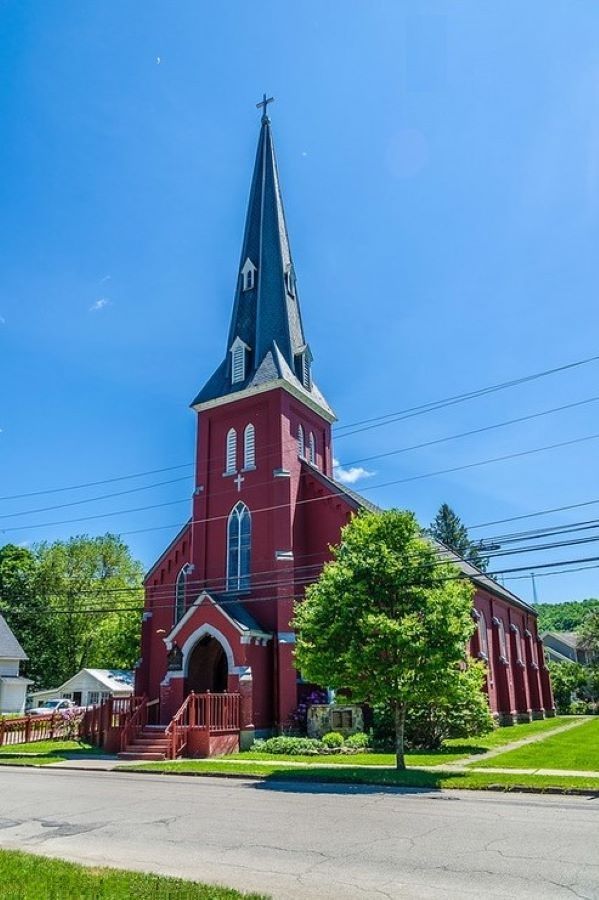
Something missing or not quite correct?Add ImageorSuggest an Edit
STOPLISTS
No stoplist details are available. If you have stoplists, please consider sharing them with us.
Something missing?Add StoplistorSuggest an Edit
CONSOLES
Builder: Garret House
Position: Keydesk Attached
Design: Traditional With a Keyboard Cover That Can Be Lifted To Form a Music Rack
Pedalboard Type: Flat Straight
Features:
1 Manuals 2 DivisionsMechanical (Unknown) Key ActionMechanical Stop ActionStop Layout: Drawknobs in Horizontal Rows on Terraced/Stepped Jambs
Expression Type: Trigger/Hitch-Down Expression
Combination Action: Unknown
Control System: Unknown or N/A
Something missing or not quite correct?Add ConsoleorSuggest an Edit
DETAILS
This instrument is: Extant and Not Playable in this location
Early in 2025 the church was closed and the congregation consolidated with another parish. The fate of the building and its contents is now in the hands of the diocese.
Scot Huntington on March 30th, 2024:
In 2024, this parish no longer has a resident priest, is no longer independently active, nor is the building open at any time other than for 8:00 am Mass on Sunday morning. Blessed Sacrament is now affiliated with the St. Jude/St. Brendan parish of Alfred and Almond, with the priest in charge and rectory located in Almond. It has been 30 years since I have been able to gain entrance to the building, so cannot confirm whether the Garret House artifact is in fact still extant.
Database Manager on January 6th, 2013:
Updated through online information from Scot Huntington. -- The organ was installed in the center of the rear gallery, extending into the bell tower of the brick building built in 1885. In the late 1960s, the still playable organ was ruined when a parishioner sawed off the keydesk with a chainsaw to permit the installation of a spinet electronic against the case front in the very shallow gallery. At the same time, to reduce drafts from the bell tower, the pedal chest and pipes across the rear of the organ had been removed so a wall could be built across the rear of the organ, thereby partially encapsulating it. What was still evident when I was last saw the organ was the following:
- the organ had one manual and pedal, the pipework was enclosed with the exception of the speaking facade basses of the Open Diapason.
- The rear tuning panel was missing, through which it could be ascertained 4 or 5 ranks still existed in whole or in part.
- The slider chest had 5 sliders connecting to stop action on the right side, and two on the left.
- The organ once had a water motor, and the original pump handle was under the double-rise reservoir.
- Part of the key action beyond the guillotined keyboard was still extant: square-horizontal roller board-square-pulldown-pallet.
- The simple case was oak. stained dark, and the handsomely decorated pipe-fence facade had no woodwork above the impost.
- The facade arrangement was 3-13-3, and the two outside flats were open wood basses 1-6 of the Open Diapason 8' (one missing, stored in the tower),
- The pipes were decorated as follows: pale robin's egg blue feet, bodies having gilded and decorated mouths, red and gold cigar banding with a gold
and nos. 7-12 were interspersed with dummies in the metal-pipe central flat.
cross stenciled across the five largest center pipes, against a grayish blue-green ground.
The walls of the building had long ago begun to splay outwards, and iron stabilizer rods were installed to hold the walls together, one of which was directly in front of the organ. Further investigation is required to determine if any remains of this historic instrument are still extant.
Database Manager on October 30th, 2004:
Status Note: There 1960
Database Manager on October 30th, 2004:
Keydesk gone by c. 1960. Unplayable.
Something missing or not quite correct?Add NoteorAdd WebpageorAdd Cross ReferenceorSuggest an Edit